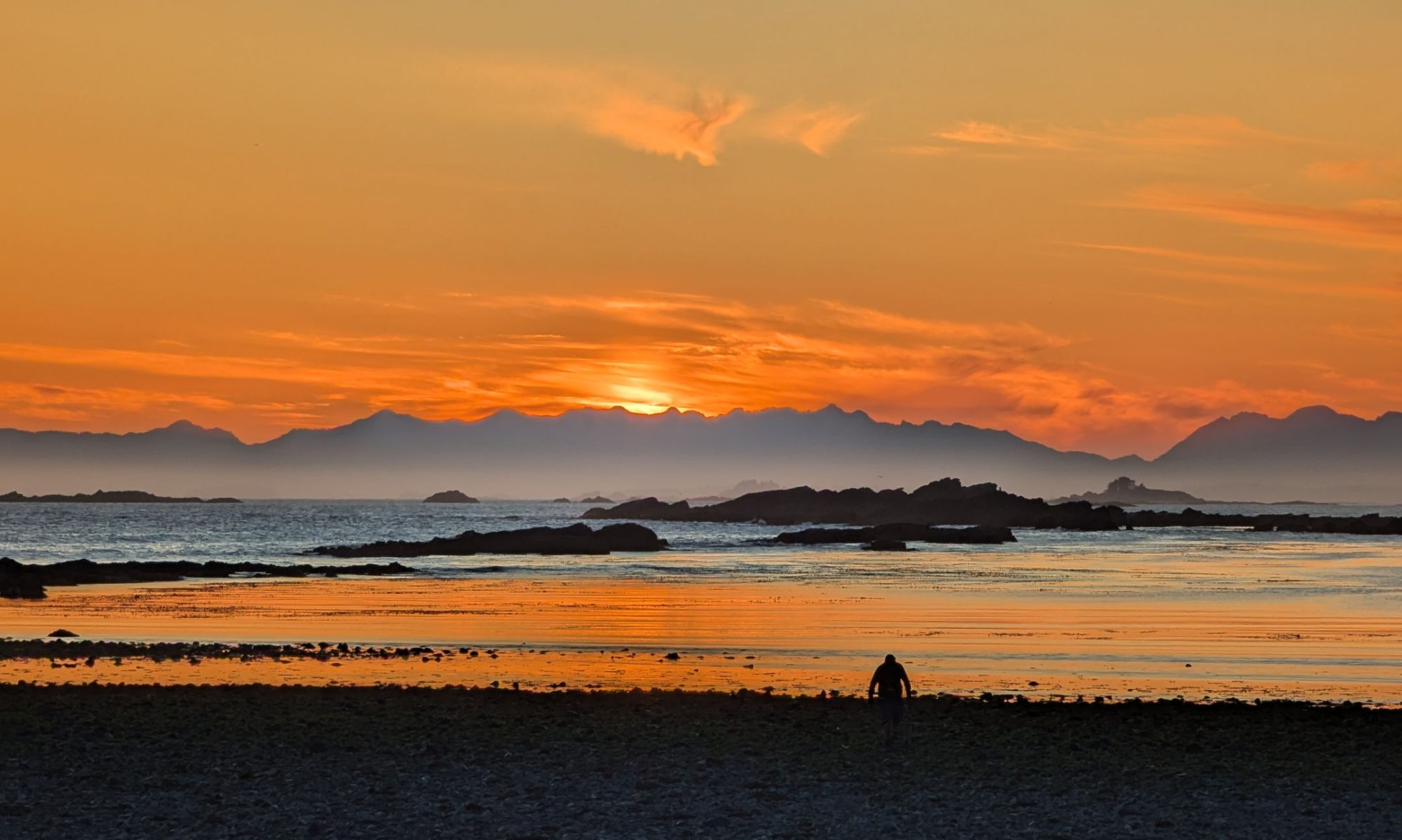
Santiago Mountain rises from the shores of Tahsis Inlet on the west coast of Vancouver Island. From its summit, you can see some of the best views of Nootka Island, Tahsis Inlet, and some of the islandβs most prominent peaks. Yet, for all its selling points, Santiago Mountain sees very few summits. At 1485 metres, this bushy peak’s summit barely reaches the alpine, but still includes enough tree-climbing, exposed scrambling, exposed tree climbing, and long, steep snow slopes to deter most island mountaineers from catching the views. How many have done so is a matter of debate: thereβs no summit register to document the ascents βprobably not worth itβand in our research we could only find one trip report, the evidence of at least one other via a rusted aerosol can on the summit, and shared word-of-mouth about one other person to successfully summit.
Brooke and Ramsay, on the down route from Santiago Mountain
Distance: 12.5 km
Starting Elevation: 458 m
Maximum Elevation: 1292 m
Total Elevation Gain: 882 m
Total Time: 10 hours
Five members met up at the Wood Mountain parking lot for a snowshoe to Mt Becher in the sunshine.
We departed at 9:45 am mostly following the summer route. There was only one other person on the trail whom we played leapfrog with up to the summit. We arrived at the summit around 12:30 pm where we experienced the rarity of no wind and clear views of the surrounding mountains all to ourselves.
After a short lunch break, we headed back along the same route, where we encountered several groups of people on snowshoes and backcountry skiers as well as their dogs. We arrived back to the vehicles at 3:00 pm.
We don’t often get a whole day together for just the two of us. Typically, the entire family goes on our adventures, or at the very least it’s you, Hemingway, and me. In fact, that was the original arrangement, for you both to come with me –and 12 of my closest Ramblers buddies– on our February 3rdΒ summit of Mount Elma. But Hemingway decided to stay home for a swim lesson and his first overnight camping trip away from home, leaving the whole day for just us–our first time!
–submitted by Matthew Lettington, originally published on explorington.com
Mountains are changeable. From a technical perspective, a route may be an easy ascent in the winter season, and a heinous, bush-filled scramble in the summer. Or, of course, it’s possible that winter adds more treachery to a route thatβs a simple scramble in the summer. It’s probablyΒ because of this duality that first ascents and first winter ascents are documented as different feats.
Thtere’s always time to stop and admire the beasts
I’ll count Big Den Mountain among those peaks that become more complicated when the snow melts. In the winter, Big Den Mountain was an aesthetic, though steep, winter ascent with some adventure between beautiful, mature trees. But in the summer, the approach became a complicated bushy route with at least one unexpected scramble.
Total Distance: 7.2 km Starting Elevation: 789 m Maximum Elevation: 1419 m Total Elevation Gain: 724 m Total Time: 4 hours, 43 minutes and 34 seconds
We watched the weather all week with mostly changing conditions and fingers crossed that our hike would return to an overcast day. Unfortunately the forecast was correct and we started our hike at 7:45am at Raven Lodge in the rain. Although we all donned our headlamps, the sky had lightened just enough to not need them.
After a few adjustments to our equipment, we set off through the trails. Although each of us had hiked in the area before, none of us had led a trip to this objective and therefore we relied upon our navigation device and gpx track to steer us in the right direction. For approximately the first half of our trip towards our summit, we were thankful to utilize the snowshoe trails. However, since the onset of the warm weather, we found we were still sinking significantly most of our steps. We crossed the popular bridge, high above the base of the bridge, and wound our way through the trails, across several groomed cross country ski tracks.
Since beginning my project to summit all the peaks in Island Alpine, I’ve spent more time exploring the various unknownΒ peaks and ranges of VancouverΒ Island than I ever spent hiking more well-known objectives. Sometimes, when I think about the time I’ve spent hiking, driving, and reporting– it’s become very time-consuming– I wonder, Is it worth it? Why am I doing this? Am I still having fun?
These questions are usually fleeting, but they strike like an avalanche. With more than two dozen trip reports in various forms of drafts, it’s a problem that seems impossible to surmount.Β Especially considering that these were some of the most important trips I’ve done over the past three years: Nootka Island; West Coast Trail; Augerpoint Traverse;Β Hesquiat Peninsula; three different seven-day kayak trips; Tatchu Peninsula; my Rambler Peak Trip where we summited Devoe and Slocomb; and a half-dozen family trips. These, and about a dozen other daytrips that I haven’t even started writing, add to the overwhelming workload I’ve created. I just can’t seem to keep on top of it. And if I’m not committed to doing them all, then why even do any of it?
Surprisingly, this lost and overwhelming feeling is one that I’ve grown accustomedΒ to in my life. Although it’s easy to be subsumed by the feeling, there is also a small comfort that comes with it. I imagine it compares to an explorer crossing an ocean to an unknown destination: there’s probably something on the other side, and there’s definitely something behind you. The farther you get from the known shore, the braver you must be. Without landmarks to position oneself, it’s difficult to take stock of progress, and sometimes you just have to trust you’re heading in the right direction.
But taking notice of my accomplishments is the key to navigating through the sea of hopelessness, and that’s why I write these reports. On December 1, I was one of a group of six that summited Big Tree Peak in the Prince of Wales Range. The peak itself is hardly worth noting; it’s not the highest, bushiest, or most challenging, nor does it have the best view of all the peaks in the Range. However, it was the final peak I needed to summit in the range. And for that reason, it’s important to take note: I’m making progress.
Big Tree Peak Route
Total Distance: 7.2 km
Starting Elevation: 789 m
Maximum Elevation: 1419 m
Total Elevation Gain: 724 m
Total Time: 4 hours, 43 minutes and 34 seconds
–submitted by Matthew Lettington; originally published on explorington.com
Back in early November, before we had even a light frost back home, I joined my core group of mountaineering buddies –with a few notable absences– on a trip to Stevens Peak. We planned to summit the mountain by following the east ridge from a spur of the Canton Creek mainline. Our research promised a straightforward approach, and the forecast predicted a splendid day with clear skies and sunshine. None of this held to be true.
don’t be fooled, that isn’t the summit
Total Distance: 11.7 km
Starting Elevation: 659 m
Maximum Elevation: 1504 m
Total Elevation Gain: 1339 m
Total Time: 8 hours https://drive.google.com/open?id=1BojbPMRuE9CIEELkAwnOSM-T9uX79ulx&usp=sharing
This trip received so much interest initially that a second trip running the opposite direction was scheduled and Julianna W graciously agreed to lead the second trip, although she was very quick to call shotgun on the downhill version β somehow predicting the benefit of finishing the day with lakes, rivers and rapids along the trail rather than starting the day against the flow. Β By the morning of the trip, partly due to normal attrition and partly (mostly) due to an βinclement forecastβ the overall group size shrunk to 9 and we all started from Raven Lodge for a generally downhill ramble to Wood Mountain.
The transition between summer and fall was exceptionally rapid this year. After months of hot, dry weather, a cold front rolled in and brought temperatures below ten degrees and a deluge of rain that seemed to last for weeks. Even my five-year-old son noticed the change: “Dad, is it fall now?” Apparently so.
For me, the seasonal transition marks a time to reflect on my summer of accomplishments and disappointments, and to set new goals! New goals give me something to look forward to during the upcoming winter and help me plan out the next summer (I’ve already planned more than twenty days of trips for summer 2019). Between Phil and me, we have a lengthy list of multi-day adventures that we have been putting off, and this is the year to do them.
Phil on the summit ridge– it looks far!
Part of the planning for these trips is observing the inspiration that comes from reviewing the accomplishments of my online friends, via social media feeds. This summer, the algorithmsΒ inundated me with many stories aboutΒ canyoneering. But, because I’m still only halfway through my Island Alpine Quest –a massive list of peaks– I didn’tΒ dare dream too deeply, because I am committed to my current obsession. Perhaps this is why I never imagined finding myself in a steep-walled canyon, and I certainly never expected that experience to come on the descent of Mount Leighton, but that’s precisely what happened.
Total Distance: 11.3 km
Starting Elevation: 363 m
Maximum Elevation: 1409 m
Total Elevation Gain: 1086 m
Total Time: 7 hours, 41 minutes
Beautiful area.Β Easy canoe voyage across the lake, nice open switch backs to the alpine and easy terrain spotted with turquoise lakes in Marble Meadows.Β Complete with Karst sinkholes, caves and fossils galore.Β Easy camping, good water (even after this very dry summer) and tall, but not difficult, mountains.Β The whole group successfully climbed both peaks we set out for, and five of us added Marble Peak as an extra (a bit spicy and exposed).Β Spent the one rainy evening/night in Wheaton Hut luxury.Β Could have easily done the trip beginning Saturday morning early (we started Friday afternoon).Β Wind at our backs both ways across the lake!