–submitted by Matthew Lettington; originally published on explorington.com
Back in early November, before we had even a light frost back home, I joined my core group of mountaineering buddies –with a few notable absences– on a trip to Stevens Peak. We planned to summit the mountain by following the east ridge from a spur of the Canton Creek mainline. Our research promised a straightforward approach, and the forecast predicted a splendid day with clear skies and sunshine. None of this held to be true.
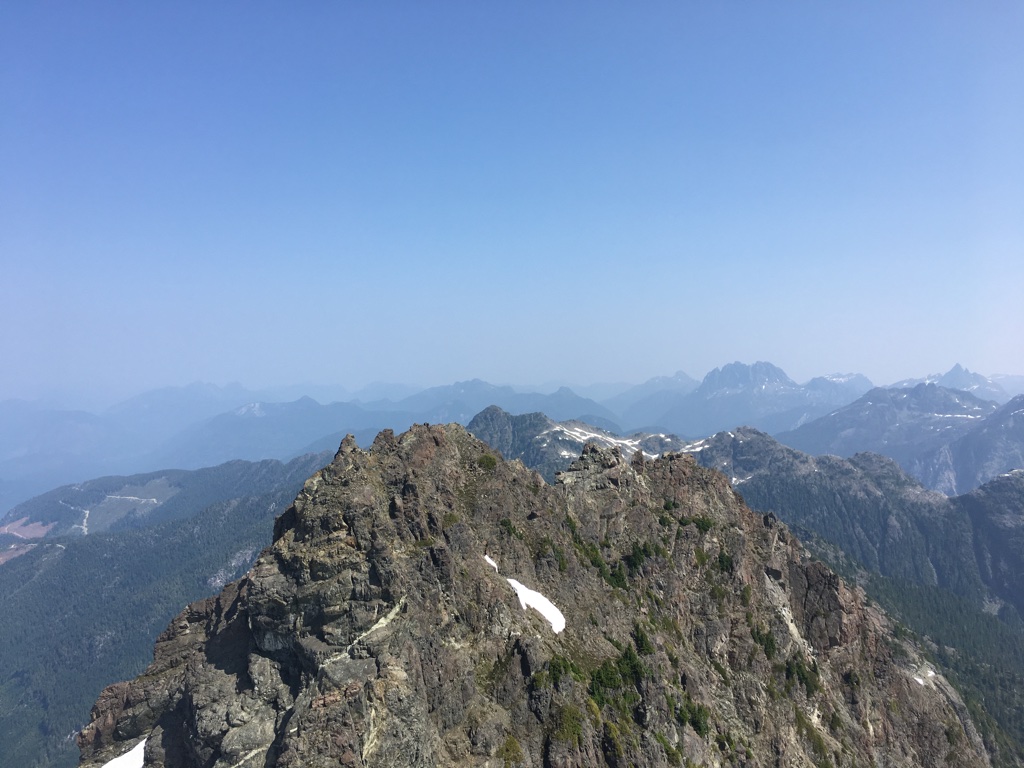
don’t be fooled, that isn’t the summit
Total Distance: 11.7 km
Starting Elevation: 659 m
Maximum Elevation: 1504 m
Total Elevation Gain: 1339 m
Total Time: 8 hours https://drive.google.com/open?id=1BojbPMRuE9CIEELkAwnOSM-T9uX79ulx&usp=sharing
On my journey to summit all the peaks on my Island Alpine Quest, I don’t often find time to hike a mountain more than once, but when I do, it’s because I’m hiking with my children. On October 27, I led a group of ten that included Hemingway and Octavia on a quick trip to Gemini Mountain in the Nanaimo Lakes area. It was a less than perfect day: cold wind made short work of our layers, cutting through our clothes to thoroughly chill us, but we took the chance to cross the saddle between the two peaks and scramble to the summit of the second bump.
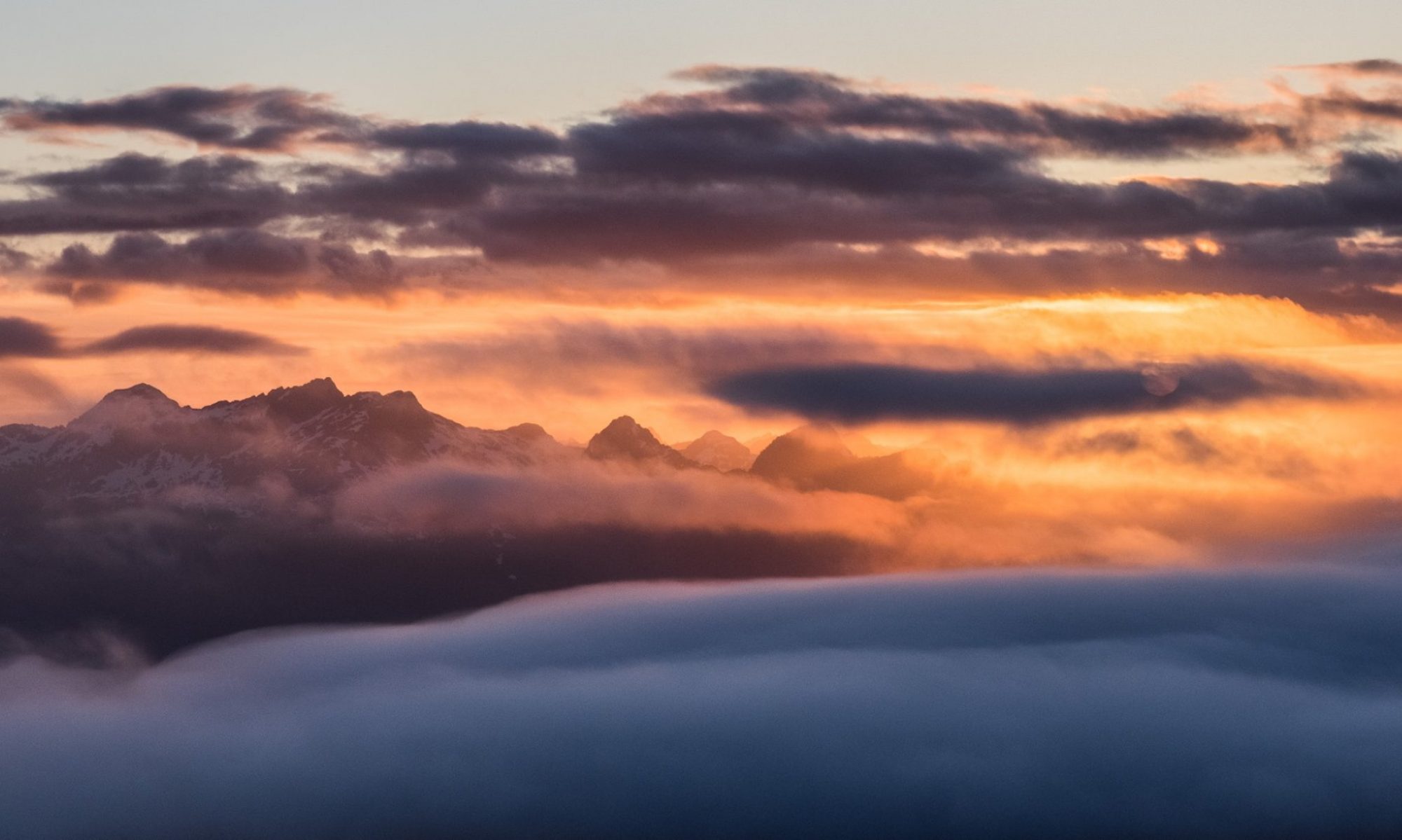
the clouds lifting from the sub-summit of Gemini Mountain
My first visit to Gemini Mountain was on a bleak, blustery day, back in 2016. It was the type of day where we wore our jackets, gloves and toques, and by the end of the hike, our gloves were filled with icy water. Relative to that trip, this one was an improvement in almost every metric. But it was still frosty, and above 1300 metres we found ice on the tops of puddles– Hemingway took delight in smashing the ice with a hiking pole.
Total Distance: 5.7 km
Starting Elevation: 1138 m
Maximum Elevation: 1518 m
Total Elevation Gain: 626 m
Total Time: 5h 44m
Winter 2018 took its sweet time arriving on Vancouver Island. Many Vancouver Islanders eagerly watched the forecast as they tuned their skis and took stock of their winter gear. I too anticipated a beautiful winter pursuing adventure in the white stuff. Yet, by late October we were still waiting for the first hints of snow to hit the alpine. Fortunately, in the seemingly endless wait between the hot summer and the white stuff, there was a lot of fantastic fall hiking.
That bump is listed as the summit; har har
On October 18th we had a fantastic day; ideal for the type of hiking we wanted to do in the Prince of Wales Range. I love hiking the peaks in this range. They offer easy access to what I’d call mostly-easy hiking–except for the bush. And on top of the quality of the hiking, the mountains, Roberts, H’Kusam, Springer, Stow, Milner, Kitchener, High Rigger, and Big Tree all offer stellar eastward views of the Johnstone Strait. Plus, if you have a clear day you get views of the Coast Ranges including Mount Waddington; while, to the west Victoria and Warden stand prominently on the horizon. The views are tough to beat (in my opinion only surpassed by the view from Tyee Mountain).
Mount Roberts Route and GPX by request
Total Distance: 12.9 km
Starting Elevation: 744 m
Maximum Elevation: 1485 m
Total Elevation Gain: 878 m
Total Time: 7 hours Continue reading “Mount Rorberts”
**apologies for the images; I forgot my camera at home and used my phone to document this trip.
Fall 2019 brought the full spectrum of weather. Through many weekends in September and into October, we trudged through dense, wet bush, and on October 13th and 14th, we were treated to a delightful sunny fall weekend. To celebrate the two days of uncharacteristically beautiful weather, I hiked first to Green Mountain with my kids, and then to Tsitika Mountain in the Franklin Range.
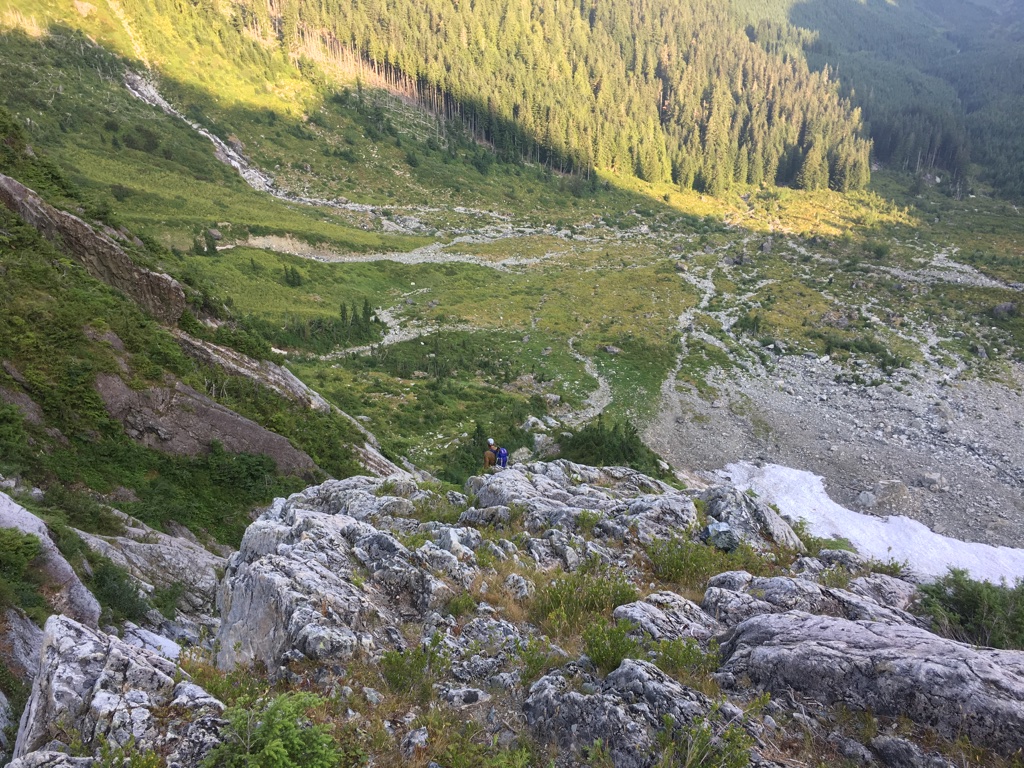
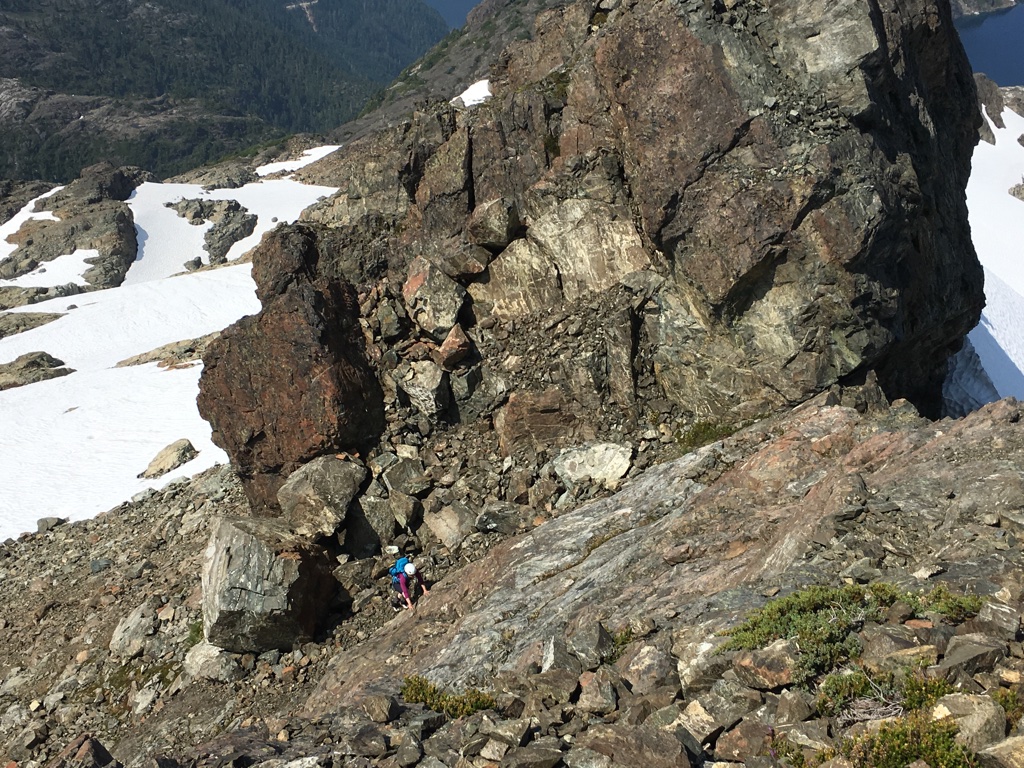
Phil and Israel, approaching the crack.
Before setting Tsitika Mountain as our objective, I had only heard of the mountain earlier this year, when I stood atop Mount Derby. At that time, I was just inside the Mount Derby Ecological Reserve, nursing some seriously wet feet, while trying to wait out the dense cloud mass that hung all around us. On October 14th, I was happy to take advantage of the dry, sunny weather and finally set eyes on Tsitika.
The drive along the logging road was quick considering the distance. The Tsitika Main parallels the river and penetrates deep into the Tsitika River valley. After crossing the river, the road becomes the Catherine Main and leads along the Catherine Creek. Eventually we diverted off the main road and followed the deactivated spur off Mudge Main to its terminus at 740 metres of elevation. After parking, I noted that we were only 250 metres from the Tsitika Mountain Ecological Reserve (poorly named as most of the mountain isn’t even in the reserve); nothing like logging right up to the edge!
Wet. It was wet. It was very wet. This doesn’t even come close to describing how wet we were by the end of the day. It was the kind of day where any effort or equipment used to contravene the water would result in failure; so, we left our raingear in our backpacks with our dry clothes in case we needed them to get warm—a smart decision. It was the kind of day where I saw water well out of the cuff of Clarke’s boot when he stepped down onto a rock, and oozing out of the tongue of Phil’s boot when he flexed his toes.
these are the faces of fatigue
Total Distance: 9 km
Starting Elevation: 225 m
Maximum Elevation: 1258 m
Total Elevation Gain: 1140 m
Total Time: 9 h 15 m
The transition between summer and fall was exceptionally rapid this year. After months of hot, dry weather, a cold front rolled in and brought temperatures below ten degrees and a deluge of rain that seemed to last for weeks. Even my five-year-old son noticed the change: “Dad, is it fall now?” Apparently so.
For me, the seasonal transition marks a time to reflect on my summer of accomplishments and disappointments, and to set new goals! New goals give me something to look forward to during the upcoming winter and help me plan out the next summer (I’ve already planned more than twenty days of trips for summer 2019). Between Phil and me, we have a lengthy list of multi-day adventures that we have been putting off, and this is the year to do them.
Phil on the summit ridge– it looks far!
Part of the planning for these trips is observing the inspiration that comes from reviewing the accomplishments of my online friends, via social media feeds. This summer, the algorithms inundated me with many stories about canyoneering. But, because I’m still only halfway through my Island Alpine Quest –a massive list of peaks– I didn’t dare dream too deeply, because I am committed to my current obsession. Perhaps this is why I never imagined finding myself in a steep-walled canyon, and I certainly never expected that experience to come on the descent of Mount Leighton, but that’s precisely what happened.
Total Distance: 11.3 km
Starting Elevation: 363 m
Maximum Elevation: 1409 m
Total Elevation Gain: 1086 m
Total Time: 7 hours, 41 minutes
Route planning is among the most important parts of trip planning. It influences equipment choices, time estimates, and helps one visualize the role environmental conditions will play on the expected terrain. Sometimes route planning is easy; the most popular routes have trails, booted track, well-documented maps, GPS tracks, and dozens of trip reports. And sometimes, it’s not so easy – for example, my trip to Watchtower Peak in the Sutton Range. A key difference between easy and challenging routes is the beta available.
Watchtower Peak wasn’t our primary objective for the weekend and so Phil and I had the one-paragraph description in Island Alpine (2002) to rely on. It boils down to three points: Gain the ridge; Follow the ridge; Avoid troubles on the left side. A key part of using any beta is interpreting the information and its validity. First, you have to the question if the author is describing the route based on their first-hand experience and what their individual experience level is; Or, if it isn’t first-hand knowledge how reliable was their source. Assuming that you trust the resource, you have the job of interpreting the route description and reconciling it to the terrain. This experience might be lived out while neck-deep in some mountain hemlock looking for the edge of a cliff you may or may not be standing on, or even whilst dangling into a gully trying to decide if the route “goes”.
Warden and Victoria in the background
On the other side of the coin, there’s the trick of writing a trip report. It’s always challenging for me to parse the information in a way that will be meaningful for those who hope to do a trip of their own. A big fault for some of my reports is their depth of detail; giving too many details can be just as harmful –maybe more, even—as giving a report with too little information. Yet, here we are with another trip report. Hopefully I can avoid being both too sparse and too detailed.
I struggle to find a balance between work, play, and family. When it comes to my annual vacation, I pack in as much playtime as I can, and this means I often leave my family at home while I’m off on an adventure. With my busy schedule, sometimes I’m unpacking one backpack by putting gear straight into a different one. This is exactly what happened on my August 13-15 backpacking trip to Mount Phillips. On August 10th, I hiked off the Augerpoint Traverse; with the next trip only a few days away, I didn’t have time to put anything away before getting ready for my family backpacking trip to Arnica Lake and Mount Phillips in Strathcona Park.
We had an ideal forecast, and if not for the haze of smoke in the air from forest fires, it would have been perfect conditions. Fortunately, the smoke didn’t hinder our breathing – it only obscured some of the otherwise amazing views.
alpine meadows that any bear would love
In addition to my wife and two children, I led a group of five Island Mountain Ramblers on a trip that I offered as an easy backpacking trip. The trip was split into three days, and the lion’s share of the distance and half of the elevation was planned along the well-manicured trail to Arnica Lake, where we set up a basecamp for two nights. Of course, the second half of the trip, out to Mount Phillips, is where the suffering was found.
Eden Mountain is a high point among a series of bumps that form an aesthetic ridge in the Genesis Range. Like many peaks in the region, it’s seldom summited, has little in the way of trip report beta, and is nestled among a series of twisting logging roads. The trip reports we found were nearly useless, because they report approaches from a now-inaccessible and well-overgrown logging road. On July 15th, just two days after returning from a week-long adventure on the North Coast Trail, I joined a group of six Island Mountain Ramblers on our first attempt to summit Eden Mountain from the terminus of the CC800 spur off Compton Creek Mainline (~910m).
We anticipated a quick trip, as the total elevation gain and horizontal distance promised to be low; just 1.5 kilometers from the car as the crow flies, and 800 meters elevation gain. We could even see the summit from the car, rising high above the logging slash, bluffs, and bush. Of course, I’ve played this game before and know full well that regardless of the metrics, simple trips can turn into day-long adventures that leave me scratched, bruised, dirty, and bitten. The trip to Eden Mountain was made long because of four long waits while we moved people through two tricky pieces of terrain.