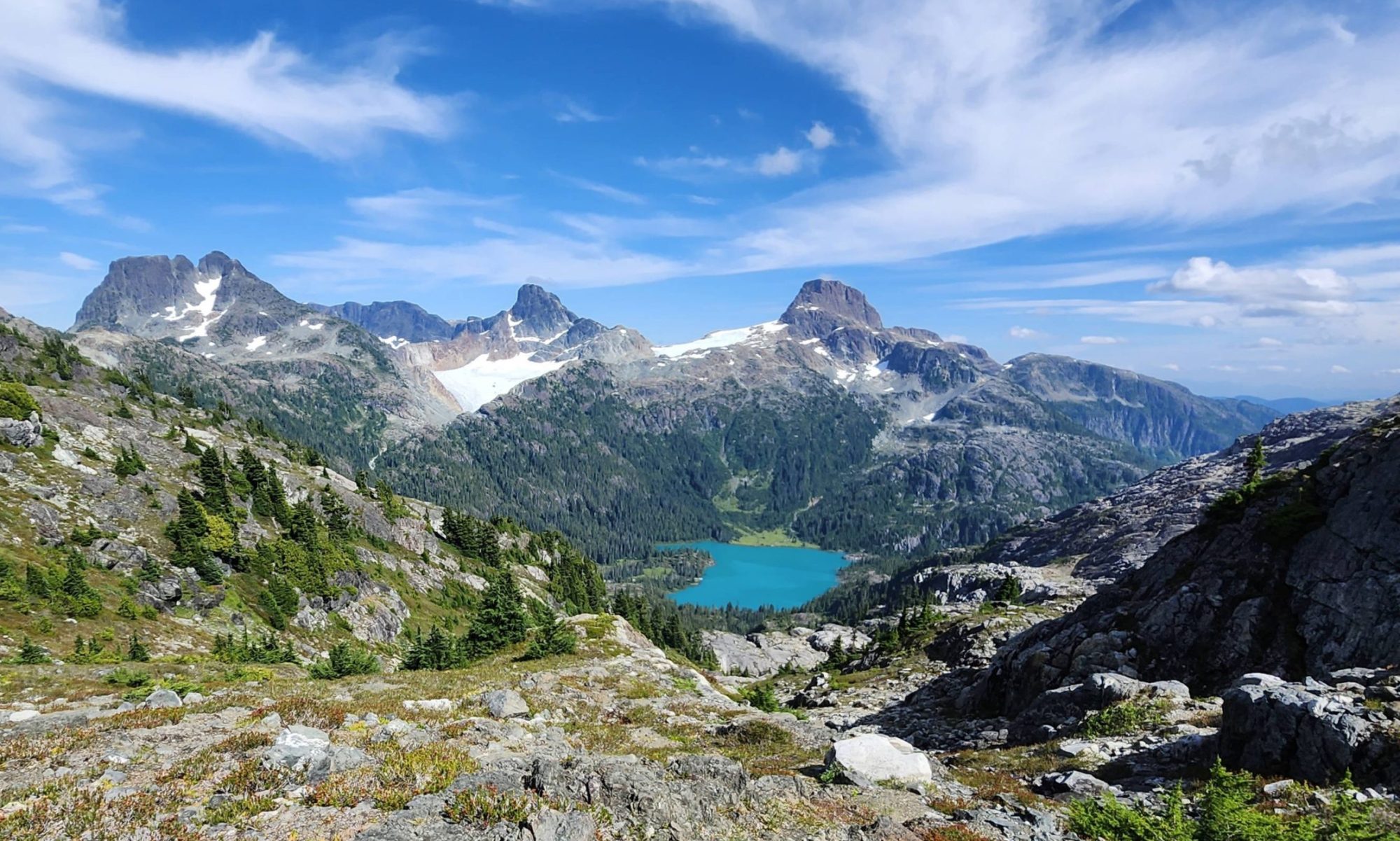
Six of us met at Providence Farm for a short car shuttle for our hike across the Tzouhalem ridge. Started with winter jackets but soon we were just down to shirts. The views were beautiful, not many trees down, and the company great. Three were members and three were from my hiking club from Cowichan. A wonderful day to be out.
Since beginning my project to summit all the peaks in Island Alpine, I’ve spent more time exploring the various unknown peaks and ranges of Vancouver Island than I ever spent hiking more well-known objectives. Sometimes, when I think about the time I’ve spent hiking, driving, and reporting– it’s become very time-consuming– I wonder, Is it worth it? Why am I doing this? Am I still having fun?
These questions are usually fleeting, but they strike like an avalanche. With more than two dozen trip reports in various forms of drafts, it’s a problem that seems impossible to surmount. Especially considering that these were some of the most important trips I’ve done over the past three years: Nootka Island; West Coast Trail; Augerpoint Traverse; Hesquiat Peninsula; three different seven-day kayak trips; Tatchu Peninsula; my Rambler Peak Trip where we summited Devoe and Slocomb; and a half-dozen family trips. These, and about a dozen other daytrips that I haven’t even started writing, add to the overwhelming workload I’ve created. I just can’t seem to keep on top of it. And if I’m not committed to doing them all, then why even do any of it?
Surprisingly, this lost and overwhelming feeling is one that I’ve grown accustomed to in my life. Although it’s easy to be subsumed by the feeling, there is also a small comfort that comes with it. I imagine it compares to an explorer crossing an ocean to an unknown destination: there’s probably something on the other side, and there’s definitely something behind you. The farther you get from the known shore, the braver you must be. Without landmarks to position oneself, it’s difficult to take stock of progress, and sometimes you just have to trust you’re heading in the right direction.
But taking notice of my accomplishments is the key to navigating through the sea of hopelessness, and that’s why I write these reports. On December 1, I was one of a group of six that summited Big Tree Peak in the Prince of Wales Range. The peak itself is hardly worth noting; it’s not the highest, bushiest, or most challenging, nor does it have the best view of all the peaks in the Range. However, it was the final peak I needed to summit in the range. And for that reason, it’s important to take note: I’m making progress.
Big Tree Peak Route
Total Distance: 7.2 km
Starting Elevation: 789 m
Maximum Elevation: 1419 m
Total Elevation Gain: 724 m
Total Time: 4 hours, 43 minutes and 34 seconds
What a beautiful Sunday for a hike. We did a short car shuttle from Providence Farm Store to our start on Khnippson Rd. I included Island Mountain Ramblers, Outdoor Club of Victoria, and the Cowichan Hikers.
–submitted by Matthew Lettington; originally published on explorington.com
Back in early November, before we had even a light frost back home, I joined my core group of mountaineering buddies –with a few notable absences– on a trip to Stevens Peak. We planned to summit the mountain by following the east ridge from a spur of the Canton Creek mainline. Our research promised a straightforward approach, and the forecast predicted a splendid day with clear skies and sunshine. None of this held to be true.
don’t be fooled, that isn’t the summit
Total Distance: 11.7 km
Starting Elevation: 659 m
Maximum Elevation: 1504 m
Total Elevation Gain: 1339 m
Total Time: 8 hours https://drive.google.com/open?id=1BojbPMRuE9CIEELkAwnOSM-T9uX79ulx&usp=sharing
When the weather turned to crap on October 28th, we abandoned our plan to summit Steven Peak in the Tlupana Range and turned our eyes to something much closer to home: Heather Mountain.
You may be surprised to read that I haven’t done this common south island hike, but the long logging road approach never really appealed to me, when there are so many other objectives on our list that don’t require 15 kilometres of walking on hard, unaesthetic logging road. However, earlier that week, I caught wind that the gate might be open and sent Phil a message about the possibility. Rather than walk through the downpour of rain on an unknown route on an unfamiliar mountain, we decided to make an easy day of it.
an idyllic mountain scene
We got lucky! Indeed, we did find the gate unlocked. Even better, we found that a kind soul had brushed out the upper sections of the old logging road, creating what I’ll refer to as an ATV track to the end of the road.
Total Distance: 4.8km
Starting Elevation: 1053 Em
Maximum Elevation: 1346 m
Total Elevation Gain: 392 m
Total Time: 2h 12 m
On my journey to summit all the peaks on my Island Alpine Quest, I don’t often find time to hike a mountain more than once, but when I do, it’s because I’m hiking with my children. On October 27, I led a group of ten that included Hemingway and Octavia on a quick trip to Gemini Mountain in the Nanaimo Lakes area. It was a less than perfect day: cold wind made short work of our layers, cutting through our clothes to thoroughly chill us, but we took the chance to cross the saddle between the two peaks and scramble to the summit of the second bump.
the clouds lifting from the sub-summit of Gemini Mountain
My first visit to Gemini Mountain was on a bleak, blustery day, back in 2016. It was the type of day where we wore our jackets, gloves and toques, and by the end of the hike, our gloves were filled with icy water. Relative to that trip, this one was an improvement in almost every metric. But it was still frosty, and above 1300 metres we found ice on the tops of puddles– Hemingway took delight in smashing the ice with a hiking pole.
Total Distance: 5.7 km
Starting Elevation: 1138 m
Maximum Elevation: 1518 m
Total Elevation Gain: 626 m
Total Time: 5h 44m
Winter 2018 took its sweet time arriving on Vancouver Island. Many Vancouver Islanders eagerly watched the forecast as they tuned their skis and took stock of their winter gear. I too anticipated a beautiful winter pursuing adventure in the white stuff. Yet, by late October we were still waiting for the first hints of snow to hit the alpine. Fortunately, in the seemingly endless wait between the hot summer and the white stuff, there was a lot of fantastic fall hiking.
That bump is listed as the summit; har har
On October 18th we had a fantastic day; ideal for the type of hiking we wanted to do in the Prince of Wales Range. I love hiking the peaks in this range. They offer easy access to what I’d call mostly-easy hiking–except for the bush. And on top of the quality of the hiking, the mountains, Roberts, H’Kusam, Springer, Stow, Milner, Kitchener, High Rigger, and Big Tree all offer stellar eastward views of the Johnstone Strait. Plus, if you have a clear day you get views of the Coast Ranges including Mount Waddington; while, to the west Victoria and Warden stand prominently on the horizon. The views are tough to beat (in my opinion only surpassed by the view from Tyee Mountain).
Mount Roberts Route and GPX by request
Total Distance: 12.9 km
Starting Elevation: 744 m
Maximum Elevation: 1485 m
Total Elevation Gain: 878 m
Total Time: 7 hours Continue reading “Mount Rorberts”
**apologies for the images; I forgot my camera at home and used my phone to document this trip.
Fall 2019 brought the full spectrum of weather. Through many weekends in September and into October, we trudged through dense, wet bush, and on October 13th and 14th, we were treated to a delightful sunny fall weekend. To celebrate the two days of uncharacteristically beautiful weather, I hiked first to Green Mountain with my kids, and then to Tsitika Mountain in the Franklin Range.
Phil and Israel, approaching the crack.
Before setting Tsitika Mountain as our objective, I had only heard of the mountain earlier this year, when I stood atop Mount Derby. At that time, I was just inside the Mount Derby Ecological Reserve, nursing some seriously wet feet, while trying to wait out the dense cloud mass that hung all around us. On October 14th, I was happy to take advantage of the dry, sunny weather and finally set eyes on Tsitika.
The drive along the logging road was quick considering the distance. The Tsitika Main parallels the river and penetrates deep into the Tsitika River valley. After crossing the river, the road becomes the Catherine Main and leads along the Catherine Creek. Eventually we diverted off the main road and followed the deactivated spur off Mudge Main to its terminus at 740 metres of elevation. After parking, I noted that we were only 250 metres from the Tsitika Mountain Ecological Reserve (poorly named as most of the mountain isn’t even in the reserve); nothing like logging right up to the edge!
On October 14th, I led a small group of Island Mountain Ramblers on a relaxed hike to Green Mountain. Octavia (25 months old) and Hemingway (5 years old) came with us to enjoy the day, and they were the primary reason for the pace. The weather was perfect. The frost from the evening before still lingered in the shadows, but the sun warmed the open terrain, illuminating the spectrum of colours around us, and the valley surrounding the mountain.
Release the beast
The brilliant reds, yellows, and purples of leaves dangling from branches created a rich tapestry on the hills around us. The large field of bracket ferns had already died, yet their brown corpses still stood tall, dried by the sun, and as we walked through them their feathery fronds brushed against us. The bright colours of the fall were contrasted by the stark green of the evergreens that dotted the route.
Total Distance: 5.2 km
Starting Elevation: 1085 m
Maximum Elevation: 1464 m
Total Elevation Gain: 378 m
Total Time: 3 hours, 45 minutes
Wet. It was wet. It was very wet. This doesn’t even come close to describing how wet we were by the end of the day. It was the kind of day where any effort or equipment used to contravene the water would result in failure; so, we left our raingear in our backpacks with our dry clothes in case we needed them to get warm—a smart decision. It was the kind of day where I saw water well out of the cuff of Clarke’s boot when he stepped down onto a rock, and oozing out of the tongue of Phil’s boot when he flexed his toes.
these are the faces of fatigue
Total Distance: 9 km
Starting Elevation: 225 m
Maximum Elevation: 1258 m
Total Elevation Gain: 1140 m
Total Time: 9 h 15 m